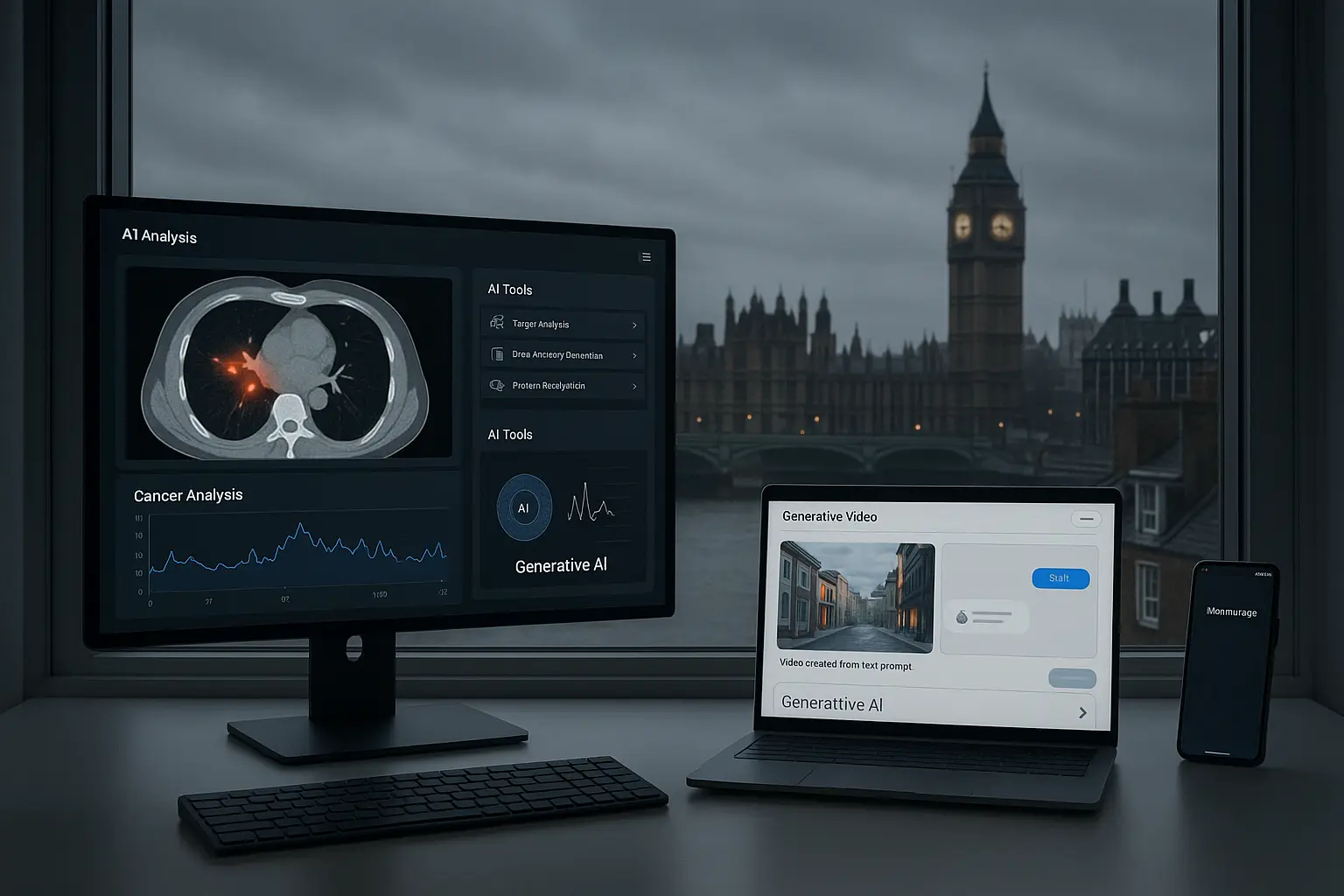
On a typical overcast morning in London, a junior oncologist navigates a cutting-edge dashboard powered by the latest technology. In moments, it highlights a subtle cancer pattern she might have overlooked. Meanwhile, her phone lights up with a message from a friend: a video generated within minutes from a simple text prompt rivaling the polish of a major studio production. These snapshots aren’t isolated breakthroughs; they embody a rapidly evolving landscape where intelligent tools are seamlessly woven into everyday work, creativity, and decision-making.
The November 2025 Surge: Real Impact Beyond the Headlines
As 2025 draws toward its close, the narrative shifts from flashy prototypes to tangible tools embraced by millions. November marked a pivotal moment not with grandiose demonstrations, but with practical, accessible solutions transforming diverse fields. Researchers, marketers, small business owners, and creatives alike found themselves empowered by a new generation of intelligent assistants.
- OpenAI’s GPT-5.1 launch redefined versatility by splitting functionality into two distinct modes: “Instant,” which prioritizes rapid, conversational responses, and “Thinking,” focused on deeper, reasoned processing. Developers gained fresh API endpoints enabling on-the-fly customization.
- Google unified its offerings through Gemini Enterprise, deploying trillion-parameter models geared for enterprise applications, healthcare breakthroughs, and consumer innovation.
- Generative video and 3D creations entered mainstream workflows, leveling the playing field for smaller teams to produce high-quality content and experiment with real-time editing.
- Note-taking and meeting automation tools such as Otter and Notegpt exponentially increased productivity for professionals by capturing, summarizing, and indexing knowledge automatically.
Head-to-Head: GPT-5.1 vs. Gemini Enterprise
Both GPT-5.1 and Gemini Enterprise symbolize the frontlines of technological advancement, yet each brings a unique flavor to the market.
| Feature | OpenAI GPT-5.1 | Google Gemini Enterprise |
|---|---|---|
| Release Date | November 2025 | October 2025 |
| Model Parameters | Undisclosed; estimated multi-trillion | 1.2 trillion (flagship) |
| Operating Modes | Instant (fast), Thinking (deep) | Enterprise, Research, Consumer |
| Core Strengths | Conversational fluency, nuanced reasoning, instant user personalization | Robust integration with Google Workspace, quantum acceleration capabilities, advanced healthcare applications |
| API Availability | Yes with new dynamic endpoints and real-time updates | Yes via Google Cloud platform |
| Key Use Cases | Customer support, education technology, creative writing, coding assistance | Business workflow automation, scientific research, embedded device intelligence |
| Security & Privacy Provisions | Enterprise-grade controls with granular user options | Corporate-level protections with Google-standard security protocols |
Generative Tools: From Novelty to Necessity
Generative tools have transitioned from experimental curiosities to essential components across industries. As of 2025, the market boasts over 1,000 verified platforms that span real-time video editing, immersive 3D scene creation, and multimedia synthesis. Product launches are now routinely amplified by AI-driven content remixing, game developers construct expansive universes within hours instead of months, and educators design personalized interactive simulations that adapt seamlessly to student needs.
According to Statista, the global generative tools market is on a trajectory to reach approximately $66.6 billion by 2026 nearly double its 2024 valuation. Meanwhile, McKinsey’s recent analysis finds that at least 70% of organizations adopting these tools realize measurable productivity improvements within the first year of integration.[8]
Transforming Healthcare: Quiet Revolution in Diagnostics and Research
Beyond headlines about generative content, the most profound breakthroughs are quietly reshaping healthcare. Today’s intelligent systems accelerate drug discovery, parse vast medical datasets, and detect rare ailments with unprecedented speed and accuracy For instance, Google’s Cell2Sentence-Scale framework harnesses vast oncology datasets to deliver insights previously achievable only in elite research labs.
MIT Technology Review recently highlighted pilot programs where diagnostic tools powered by this technology have reduced the average time-to-diagnosis by up to 30%, a staggering advance with the potential to save thousands of lives each year.
Building the Backbone: Competition in Technology Infrastructure
While many focus on applications, the battle for supremacy increasingly takes place beneath the surface—infrastructure. Giants like OpenAI, Google, Microsoft, and Amazon are investing billions into next-generation processors, cloud architectures, and edge computing platforms. Their goal: to deliver faster, more cost-effective, and universally accessible solutions.
Stanford’s 2025 AI Index report notes a dramatic 60% reduction in inference costs for leading models over just 18 months, a remarkable decrease that is democratizing access for startups and individual developers alike.
Trending Tools Defining the Modern Workbench
- Notegpt: Emerging as the dominant note-taking and meeting assistant, this platform has achieved a remarkable +99X growth rate and garners over 22,000 monthly searches as professionals seek to streamline knowledge capture.
- Replit AI Integrations: Offering direct access to more than 300 models with zero setup, empowering developers to innovate at unprecedented speed.
- ZeroGPT: A trusted tool boasting over 98% accuracy in distinguishing AI-generated text, widely adopted by publishers and academic institutions.
- SoundHound AI: Voice-enabled assistants enhancing customer engagement across devices and brands.
- Otter: Real-time transcription, summarization, and search functionality that has become indispensable in modern meetings.
The Human Element: Why Oversight Remains Crucial
One truth stands clear: technology flourishes not in isolation but in partnership with human expertise. Industry leaders emphasize that while generative tools drastically reduce production times, rigorous human review remains essential to ensure quality and maintain accuracy. The future is not a contest between humans and machines, but a collaborative ecosystem where the strengths of both are amplified at scale.
Looking Ahead: The Next Frontiers in Intelligent Tools
The momentum shows no sign of abating. As solutions become smarter and more affordable, the coming years promise advances in multimodal systems that fluently integrate text, imagery, audio, and video into unified models. Expect a surge in on-device intelligence as privacy concerns and real-time security (including scam detection) take center stage. Furthermore, verticalized platforms tailored to industries such as finance and manufacturing are poised to unleash sector-specific transformations.
For executives, developers, and users alike, the take-home message is straightforward: intelligent technology has transcended novelty and become fundamental infrastructure. The most successful organizations will be those that swiftly adapt, combining state-of-the-art tools with the sharpest human insights.