
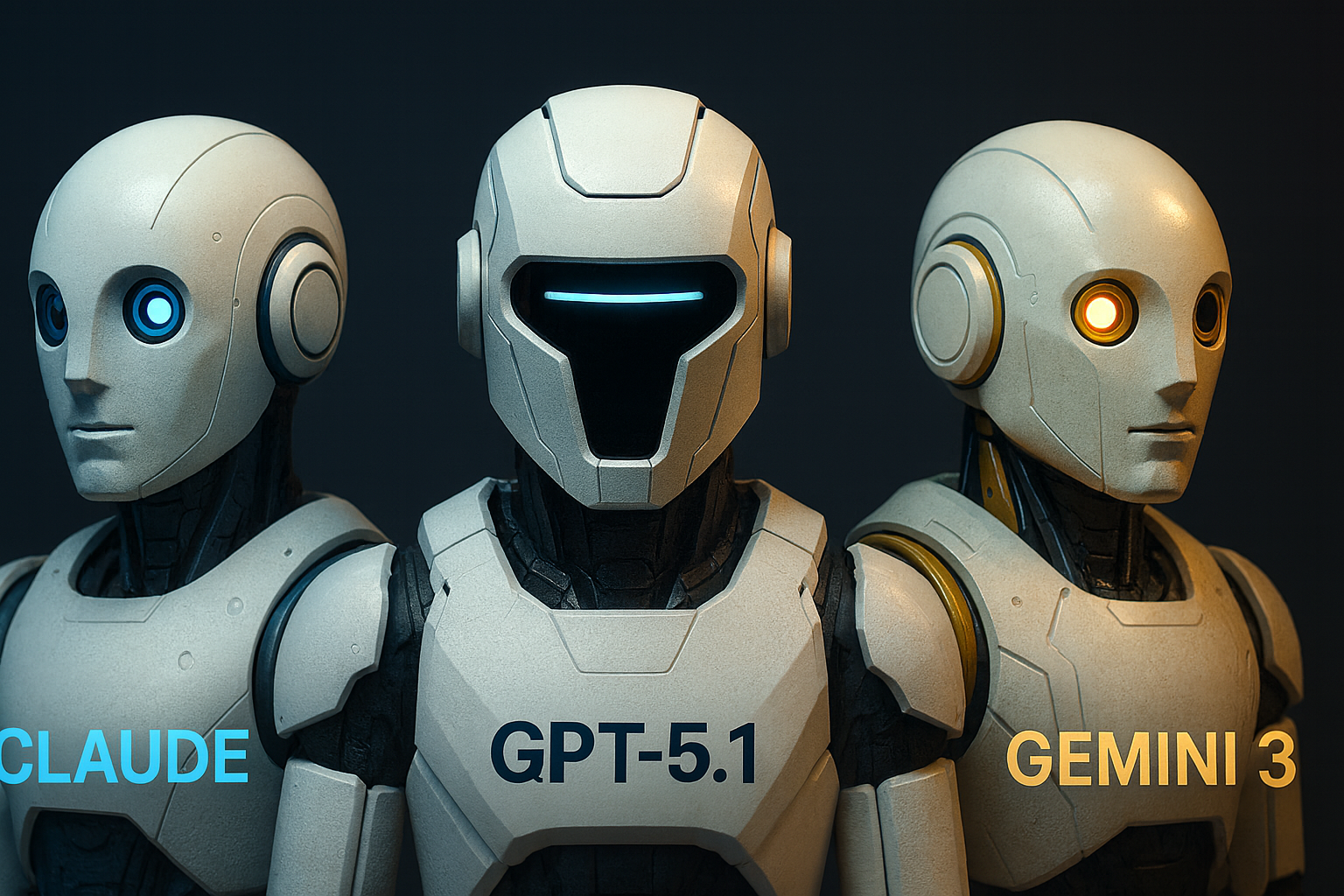
Wednesday morning at a mid-sized fintech firm began like any other until the product manager opened Slack and found not one, but three major announcements landing within hours. Anthropic’s Claude Opus 4.5 had just shipped, OpenAI’s GPT-5.1 was now live on the API, and Google’s Gemini 3 had shattered a benchmark no system had previously reached. With a Friday deadline looming to decide which model to embed into their compliance automation, she faced a dilemma emblematic of a new era: November 2025, when the cutting edge became a complex procurement challenge rather than a distant buzzword.
For the first time, enterprises no longer pick between the latest innovations and legacy systems they choose among three highly competitive, state-of-the-art offerings released almost simultaneously. Each boasts unique strengths, distinct pricing models, and fundamentally different architectural philosophies. This rare convergence isn’t just a milestone; it signals an industry pivot away from vendor lock-in toward a truly pluralistic market. The days of putting all your chips on one platform are fading fast.
November 2025: A Turning Point in Model Releases
Between November 13 and 18, the three tech giants behind the largest foundational models unveiled their latest breakthroughs, setting the stage for what is now commonly called the “great model showdown.” The timing was deliberate, less a coincidence and more a testament to the fierce competition redefining the sector.
OpenAI’s GPT-5.1 arrived first on November 13. Rather than a radical reinvention, it’s an iterative upgrade focused on refinement. Offering two variants GPT-5.1 Instant optimized for speed and fluidity, and GPT-5.1 Thinking geared towards complex reasoning its standout feature is “adaptive thinking.” The model dynamically determines when to invoke deep reasoning, balancing speed with sophistication to avoid the lag common in earlier designs. Coupled with extended prompt caching (now holding context for up to 24 hours) and developer-friendly tools like apply_patch and shell, OpenAI’s latest aims to support agentic workflows far beyond basic chat.
Google’s Gemini 3 launched just days later, on November 18, grabbing headlines by exceeding 1501 points on the LMArena leaderboard for the first time. While leaderboard scores are one metric, the real breakthrough lies in Gemini 3’s native multimodal reasoning abilities seamlessly processing text, images, audio, and video with equal finesse. This is a leap forward, positioning Google as a formidable match to OpenAI in nuanced reasoning tasks. Importantly, Gemini 3 introduces “generative interfaces,” which auto-generate rich visual layouts and interactive elements rather than settling for plain text outputs signaling a breakthrough in user experience design.
Anthropic’s Claude Opus 4.5 also debuted in this window, turning heads for defying prior assumptions about the Claude brand being primarily a “safety-first” alternative. Opus 4.5 surpasses human performance on technical assessments and leads the SWE-bench Verified benchmark for software engineering excellence. Its capabilities extend far beyond conversation; the model excels at agent tasks navigating complex interfaces, generating and debugging code, and problem-solving with agility previously unseen in earlier iterations. Enhanced safety measures, including robust defenses against prompt injection, highlight Anthropic’s commitment to pairing power with reliability.
Comparing the Contenders: Core Strengths and Differentiators
| Capability | GPT-5.1 | Claude Opus 4.5 | Gemini 3 |
|---|---|---|---|
| Reasoning Speed | Adaptive; optimized for speed with selective deep reasoning | Consistent and steady performance | Designed for simultaneous multimodal processing |
| Coding Performance | Strong in agentic orchestration and task automation | Industry leader on software engineering benchmarks | Competitive but not leading |
| Multimodal Capability | Primarily text-based | Primarily text-based | Native multimodal across text, images, audio, and video |
| LMArena Elo Score | Highly competitive, undisclosed precise score | Not publicly disclosed | 1501; highest recorded to date |
| Safety and Robustness | Standard safeguards | Enhanced prompt injection resistance | Standard safeguards |
| Developer Ecosystem | Advanced patching and shell scripting tools | Comprehensive Anthropic API | Innovative generative UI interfaces |
Numbers provide part of the story, but the models embody distinct strategic philosophies. OpenAI focuses on speed and developer convenience, Anthropic prioritizes coding excellence and robustness, and Google bets on broad multimodal intelligence and enhanced interface generation. For enterprises, this means that selecting a model is less about finding a universal “best” and more about aligning specific trade-offs with their unique workflows and goals.
Why November’s Releases Resonate Beyond the Headlines
New model launches are common, but this month’s releases coincided with significant ecosystem moves that broadened the implications. Microsoft announced that GPT-5 would be the engine behind Copilot Chat, featuring a dynamic router intelligently toggling between fast and reasoning-optimized models based on task complexity. Meanwhile, Google unveiled Private AI Compute, a cloud service encrypting Gemini 3 operations end-to-end so even Google engineers can’t access user data—addressing growing privacy concerns.
These developments illustrate how the contest isn’t just about model performance anymore; it’s about where and how these models are delivered.
Industry reports estimate that over $88 billion in commitments to data center infrastructure and compute capacity were formalized in November alone. Large-scale partnerships like OpenAI and AWS’s $38 billion collaboration, Microsoft’s $15 billion investment in Anthropic alongside NVIDIA, and Mistral’s European $2 billion funding round mark a seismic shift towards infrastructure-centric competition.
As McKinsey’s 2025 Global Survey on AI highlights, the industry now places greater emphasis on deployment efficiency, latency reduction, and cost optimization than on raw capabilities. For businesses, the most advanced model is irrelevant if it’s locked behind a single cloud provider or priced prohibitively. Accessibility, integration depth, and operational agility have become the ultimate differentiators.
Emerging Leader: The Rise of Autonomous, Agentic Interfaces
Unmistakably, every major November announcement spotlighted autonomous agent capabilities. Google’s Antigravity IDE, Microsoft’s Agent 365 control plane, OpenAI’s expanding tool ecosystem, and Anthropic’s enhanced computer usage features converge on a shared vision: models that do more than answer queries they can take action, navigate environments, and make decisions on users’ behalf.
This shift signifies a watershed moment. While conversational interfaces remain foundational, the next frontier is reliable operation inside complex, real-world systems. Claude Opus 4.5’s adeptness at agent tasks reflects this understanding; OpenAI’s adaptive thinking and support tools echo it; Google’s generative interfaces seem designed to serve as the UI frameworks for agentic workflows.
Simultaneously, niche consumer tools like Udio AI rising sharply in popularity with over 60,000 monthly searches showcase an adjacent trend of specialized applications, focusing on music generation. Similarly, NotePT’s surge highlights tailored use cases in note-taking. Essentially, these frontier models are becoming the underlying infrastructure, while specialized consumer-facing apps act as interfaces.
What Enterprises Need to Consider Today
These overlapping developments complicate enterprise decisions like never before. If you are evaluating which model to deploy, consider the following dimensions carefully:
- Software Development: Claude Opus 4.5 isn’t just hype on the SWE-bench. If your primary workload involves code generation or complex technical problem-solving, its demonstrated performance gives it a distinct edge. GPT-5.1’s agent-oriented design, although powerful, tends to lean towards orchestration rather than deep coding finesse.
- Multimodal Reasoning: When your pipeline demands understanding images, audio, or video alongside text, Gemini 3 is unmatched. Its architecture is inherently multimodal, not an afterthought added to a text-trained foundation.
- Speed and Cost Efficiency: GPT-5.1 Instant’s adaptive reasoning brings a critical innovation dynamic pacing that delivers complex analysis only as needed, optimizing both latency and cost. This is especially valuable for workloads dominated by straightforward tasks punctuated with occasional complexity.
- Regulated or Safety-critical Environments: Anthropic’s emphasis on prompt injection resistance and robust safety mechanisms make Claude Opus 4.5 a compelling choice where compliance and security cannot be compromised.
Infrastructure: The New Battleground
The buzz often centers on models themselves, but the real war is upstream in infrastructure and context integration. Microsoft’s Work IQ, which ties Copilot into enterprise data streams like email, files, and meetings, exemplifies a protective moat built on knowledge graph connectivity rather than model strength alone. Meanwhile, Google’s Private AI Compute addresses enterprise privacy concerns head-on, and OpenAI’s cache extensions plus innovative developer tools enhance overall usability and deployment efficiency.
As Gartner notes in their enterprise AI adoption analysis, organizations are pivoting focus from raw capability toward practical, secure, and cost-effective production deployment. The latest investments reflect this paradigm shift, as infrastructure spending now dwarfs pure model research budgets, underlining the importance of scalability and operational resilience.
Meanwhile, the rise of European initiatives exemplified by Mistral’s $2 billion raise coupled with SAP’s involvement illustrates growing demand for regional AI sovereignty. Enterprises in regulated markets increasingly seek alternatives to US-centric providers, deepening industry fragmentation. Far from a centralized AI monolith, the future looks more like a diverse ecosystem of competing models and platforms.
Looking Ahead: Specialization and Orchestration
The pattern set by November’s releases suggests future models will continue arriving in rapid succession, each refined for specific domains. Rather than searching for a single “best” system, enterprises will soon orchestrate multiple specialist models some optimized for abstract reasoning, others for multimodal comprehension, coding, or efficient deployment.
The real race is no longer about raw intelligence. Instead, it’s a contest over ease of integration, cost-effectiveness, and deep embedding into enterprise workflows. The winning solution will be the one that enables effective orchestration across diverse systems, adapts fluidly to changing business needs, and delivers reliable service at scale.
For now, November 2025 stands as a historic turning point when choosing a foundational model became a strategic business decision, integral to enterprise architecture and operational strategy. This evolution marks significant progress and hints at a future where AI truly becomes an indispensable backbone of industry.
